Materials guide · 2026 · How we build · Costs & budgets · Permits & law
Natural building materials in Costa Rica
Bamboo, hardwood and earth all have a real history in this country, and all three are being built with today. None of them is a shortcut. Each one asks for more design, more supervision and more detailing than a block wall — and each one, done properly, gives you a house that belongs here in a way a concrete box does not.
The short answer
Four natural systems are genuinely buildable in Costa Rica right now: guadua bamboo, plantation and native timber, earth in its three forms (adobe, bahareque and compressed earth block), and lime as the finish that lets the first three breathe. Everything else — straw bale, rammed earth without stabilisation, untreated round timber — we would not put on a coastal site here without a long conversation first.
Three constraints decide which of them survives on your lot, and they apply in this order. Earthquakes, because the seismic code governs the structure before anything else does. Water, because a seven-month green season with driven rain punishes any wall that is not kept dry. And insects, because termites and powder-post beetles eat anything with starch or sapwood in it. Our build standard starts in the same place for exactly this reason.
The good news is that bamboo is one of the best seismic materials on earth, earth walls are the best thermal mass you can buy in the lowlands, and the country grows excellent timber. The catch is that all three reward a design team that knows what it is doing and punish one that does not.
Guadua bamboo
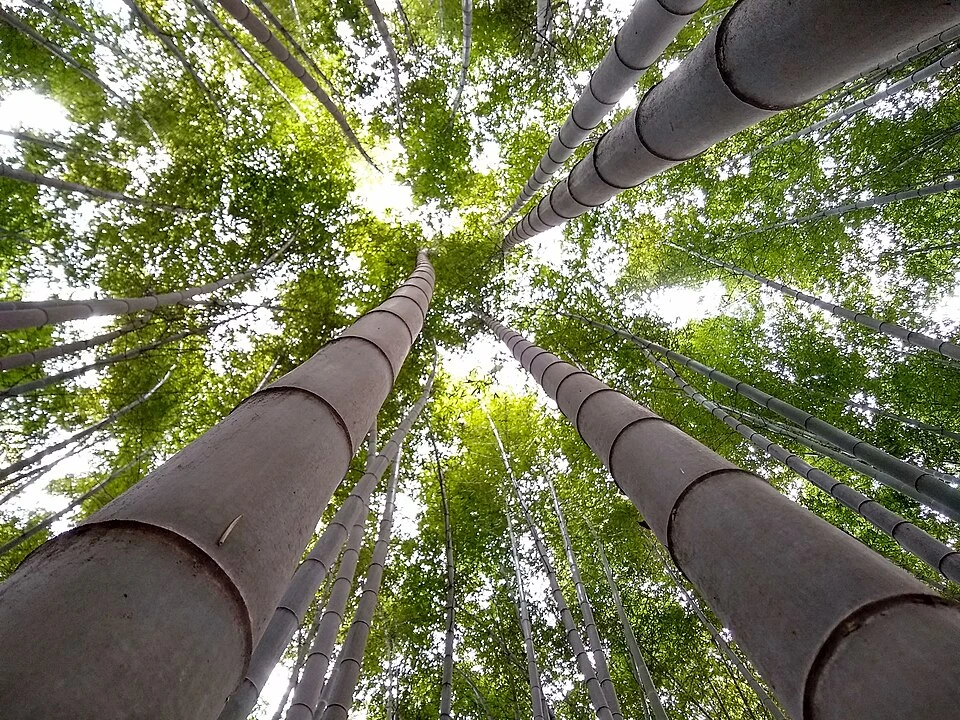
Guadua angustifolia is the structural bamboo of the Americas and it grows here. It reaches full height in months and a usable structural section in roughly four to six years, against twenty for plantation teak. In the hand it behaves like a lightweight tube of long parallel fibres: very strong in tension, very light, and extremely forgiving in an earthquake, because a light, flexible frame attracts far less seismic force than a heavy rigid one.
What makes it an engineering material rather than a romantic one is everything that happens between the grove and the frame.
- Maturity and harvest. Culms are cut at four to six years, ideally outside the wettest months, when starch content is lowest. Young culms look identical and fail differently.
- Preservative treatment. Boron salts — borax and boric acid — are carried through the culm wall by tank immersion over several days or by the Boucherie method, which pushes solution through a freshly cut culm under pressure. Without it, powder-post beetles will find the starch.
- Controlled drying. Treated culms are dried under cover to a stable moisture content before they are cut to length. Bamboo that dries in the frame splits in the frame.
- Connections. This is where bamboo buildings are won or lost. A bolt through a hollow culm crushes it; the internode is filled with grout first, so the bolt bears on something solid. Cuts land just above a node, where the diaphragm stiffens the tube.
- Permanent dryness. Boron is water-soluble. If the detailing lets rain reach the frame, the treatment leaches out and the protection goes with it.
The honest limitation
Bamboo is not a material you specify and then shop for. Supply of properly matured, treated and graded guadua is thinner than people expect, lead times are real, and the crews who can frame it well are a small group. Price the material and the crew together, early, or the design will arrive at a quote it cannot survive. We cover the same ground from the specification side under sustainable and net-zero design.
Tropical and plantation timber
Costa Rica grows good wood, and the forestry law that followed the deforestation of the 1970s and 1980s means the legal supply today is overwhelmingly plantation material rather than natural forest. For a builder that is a feature: plantation stock is documented, repeatable and available in consistent sections.
Worth specifying
- Teca (teak). The exterior workhorse. Natural oils give it real weather and insect resistance; plantation-grown and widely available.
- Cenízaro, cristóbal, pilón, guanacaste. Durable, characterful hardwoods for interior joinery, stairs and protected exterior elements.
- Laurel. Stable and workable; good for doors, cabinetry and millwork under cover.
Handle with care
- Melina. Cheap, fast-grown and everywhere — but not weather-durable untreated. Fine under a roof, poor in the rain.
- Pine, imported. Needs pressure treatment and still underperforms teak here.
- Anything without paperwork. Harvest and transport are regulated; ask for documentation of legal origin before you buy.
The detailing rules are the same ones that govern bamboo. Keep end grain out of the weather, keep timber off the ground, ventilate the back of any cladding, and assume termites are already looking. Our woodworking shop specifies by species and by exposure rather than by what is on the yard that week, which is why we would rather use melina indoors and teak outdoors than compromise in either direction.
Adobe, bahareque and earth block
Earth is the oldest wall material in the country and it comes in three forms that behave very differently under a seismic load.
| System | What it is | Where it fits |
|---|---|---|
| Adobe | Sun-dried earth blocks laid in earth mortar, in thick walls. | Excellent thermal mass for hot, dry zones such as inland Guanacaste. Heavy and brittle, so it needs confinement and a conservative structural scheme. |
| Bahareque | A braced timber or cane frame with an earth or earth-and-lime infill. | The traditional answer to a seismic country: light, ductile and repairable. The easiest earth system to make a structural case for. |
| Compressed earth block | Earth stabilised with a few per cent cement or lime, pressed into blocks. | Dimensionally accurate, far more rain-tolerant than adobe, and it lays like masonry. The most practical earth system for a contemporary house. |
Two rules apply to all three. First, the soil decides — the clay, silt and sand fractions of your own site material determine whether you can build with it at all, and that is a laboratory test, not a judgement by eye. Second, finish with lime, not cement. A cement render over an earth wall seals moisture in behind a surface it cannot escape through; lime plaster lets the wall dry outward, which is the whole reason these buildings last for centuries where they are detailed correctly.
How they compare
There is no winner here, only fit. The chart below is our own ordinal reading from built work — not measured data — with reinforced block included as the baseline every Costa Rican quote is written against.
| Material | Wet season | Seismic | Local supply | Permitting |
|---|---|---|---|---|
| Guadua bamboo | 3 / 5 | 5 / 5 | 3 / 5 | 2 / 5 |
| Plantation teak | 5 / 5 | 4 / 5 | 4 / 5 | 4 / 5 |
| Melina / laurel | 2 / 5 | 4 / 5 | 5 / 5 | 4 / 5 |
| Earth block (CEB) | 3 / 5 | 3 / 5 | 2 / 5 | 3 / 5 |
| Adobe / bahareque | 2 / 5 | 3 / 5 | 3 / 5 | 2 / 5 |
| Reinforced block | 5 / 5 | 5 / 5 | 5 / 5 | 5 / 5 |
What the shape tells you is that the natural systems cost you certainty — in supply, in permitting and in the size of the pool of crews who can build them — and pay you back in embodied carbon, thermal comfort and a building that looks like where it is. That is a fair trade for many clients. It is a bad trade for anyone on a fixed deadline with no appetite for a design team learning on their project.
Detailing for the green season
Every natural-material failure we have been called to inspect in this country comes back to water. Not a flood — just seven months of rain arriving sideways at a wall that was detailed for a drier place. The principle has a name that builders here have used for generations: good boots and a good hat.
- Overhangs sized for driven rain. On an exposed coastal or ridge site, an overhang that works in the Central Valley is not enough.
- A plinth above splash height. Earth and timber never start at ground level. Stone or concrete carries the first course, over a damp-proof course.
- Drainage away from the base. A gravel apron and a graded surface, so the water that does arrive leaves.
- Vapour-open finishes. Lime inside and out on earth; oil or breathable finishes on timber. Nothing that traps.
- Ventilation behind everything. A cavity behind cladding, air movement at the eave, and no detail that holds standing water inside a bamboo culm.
- Termite separation. Physical barriers and metal shields at every point where timber or bamboo meets the ground or the foundation.
Getting it permitted
Nothing about a natural-material house changes the process, and that surprises people. The drawings are produced and stamped by a professional registered with the CFIA, visaed through the college, and then submitted to the municipality for the construction permit, with the land-use certificate and, depending on the site, SETENA in front of all of it. Our architecture and permitting page walks the sequence in full.
What does change is the weight of the engineering argument. The seismic code CSCR-2010 governs the structure, and it does not carry a bamboo chapter the way Colombia's code does. In practice, engineers here justify a guadua structure through the international standards for bamboo design and testing — ISO 22156 and ISO 22157 — along with connection details and test data they are willing to put their stamp on. Earth walls face the same question from the other direction: how the mass is confined and what happens to it in a seismic event.
Budget time, not just money
Assume a longer review than a block submission, and assume at least one round of questions. The cost of that is measured in weeks of programme, which is why we price natural-material projects with the permitting window stretched rather than hoping it holds. Confirm current code and municipal requirements with your own CFIA-registered professional before you commit to a system.
What it does to the budget
The persistent myth is that natural materials are the cheap option. Occasionally they are. Usually they are not, and the reason is simple: these systems trade material cost for labour and skill, and skilled labour is the part of a Costa Rican build that has stopped being cheap. A guadua frame needs a crew that has framed one before. An earth wall needs more days on site than a block wall. Both need supervision a block house does not.
- Material can be cheap; the system rarely is. Count treatment, drying, grout, connectors, specialist labour and supervision, not the price per culm or per block.
- Supply is thinner, so lead times cost money. A material you have to wait for is a programme risk, and programme risk is a cost line whether or not anyone writes it down.
- Hybrids are where the economics work. A reinforced concrete frame and block service core with bamboo roof structure, timber screens and earth-block infill gives you most of the character at a fraction of the risk. Nearly every natural-material house we build is a hybrid.
- The payback is operational. Thermal mass and a breathing envelope cut cooling load in the lowlands for the life of the building — see our cost guide for how the bands move with specification, and What it costs an American to build a home in Costa Rica for the whole-project picture.
Choosing by site
The same material is a good idea on one lot and a bad one forty minutes away. Rough guidance, and no substitute for standing on the land:
Central Valley
- Mild temperatures mean thermal mass earns less. Earth is a choice about character and carbon, not comfort.
- Best supply chains in the country for timber and specialist crews.
- Municipal review is generally the most demanding — allow for it.
Guanacaste, dry north-west
- The strongest case for earth anywhere in the country: hot days, cool nights, a long dry season.
- Adobe and bahareque have a continuous local tradition here.
- Water supply, not material choice, is usually the binding constraint — see where we build.
South Pacific and Osa
- Bamboo and timber territory, culturally and practically. Ventilation beats mass in this humidity.
- Rain and termite pressure are at their highest — detailing discipline is non-negotiable.
- Remote logistics push you towards materials that can be grown or milled nearby.
Coastal and maritime-zone sites
- Salt attacks fixings before it attacks the material. Stainless or hot-dip galvanised, everywhere.
- Driven rain governs overhang depth; the Central Valley figure will not do.
- Concession land has its own rules — How to buy a house in Costa Rica as a US citizen covers the maritime zone.
If you remember five things
- Bamboo is an engineering material: mature culms, boron treatment, grouted connections, permanently dry.
- Teak outdoors, melina indoors, and documentation of legal origin for everything.
- Earth needs a soil test first and a lime finish last — never cement render.
- Good boots and a good hat. Water is what kills natural buildings here, not time.
- Permitting follows the engineering, so hire the engineer who has done it before you fall in love with the system.
Keep reading
- How we buildSeismic first, then rain, then termites
- Sustainable & net-zero designLow-carbon specification, from material to energy model
- Custom woodworkingSpecies, exposure and joinery made for this climate
- Cost to build per m²The three bands, and the site factors that move them
- What it costs an American to build a home in Costa RicaWhole-project costs, permits, taxes and currency
- The best places in Costa Rica to build a family homeClimate, schools and services, place by place
Answered
What clients ask about natural materials.
Can you build a permitted house out of bamboo in Costa Rica?
Yes, but it is an engineered building, not a craft project. Like any other house, the drawings must be produced and stamped by a professional registered with the CFIA and visaed before the municipality will issue a construction permit. Costa Rica’s seismic code CSCR-2010 does not carry a bamboo chapter the way Colombia’s NSR-10 does, so engineers here generally justify a guadua structure through the international standards for bamboo design and testing (ISO 22156 and ISO 22157) together with connection details they are willing to sign. The practical consequence is that you need an engineer who has done it before; the permit follows the engineering, not the other way round.
How is bamboo treated so insects do not eat it?
Untreated bamboo is starch-rich and will be attacked by powder-post beetles within a couple of years in this climate. The standard treatment is a boron salt — borax and boric acid in solution — pushed through the culm wall either by immersing cut culms in a tank for several days or by the Boucherie method, which forces solution through a freshly cut culm under pressure. After treatment the culms are dried under cover to a stable moisture content. Boron is water-soluble, which is exactly why treated bamboo must be kept permanently dry in the finished building: it protects timber that stays out of the rain, not timber that gets wet.
Are adobe and bahareque legal to build with in Costa Rica?
There is no prohibition on earth construction, and both have a long history here, particularly in Guanacaste. What they need is the same thing bamboo needs: a design a CFIA-registered professional will stamp, with a structural approach that satisfies the seismic code. Lightweight braced-frame systems like bahareque generally have an easier case to make than heavy unreinforced adobe walls, because mass is what hurts you in an earthquake. Expect a municipality to look harder at an earth-wall submission than at a block one, and allow extra time in the programme for it.
Which tropical hardwoods actually last outdoors here?
Teak (teca) is the reliable exterior performer, which is why plantation teak dominates serious outdoor joinery, decking and cladding. Several native hardwoods — cenízaro, cristóbal, pilón, guanacaste — are durable and beautiful for interior work and for protected exterior elements. The fast-grown plantation softwoods, melina above all, are inexpensive and widely available but are not durable in the weather without treatment and a roof over them. Whatever you buy, ask for documentation of legal origin: harvesting and transport are regulated under the forestry law, and a supplier who cannot produce paperwork is a supplier to walk away from.
Is building with natural materials cheaper than concrete block?
Usually not, once the whole job is costed. The material itself may be cheap, but these systems trade material cost for labour and skill, and skilled labour is the part of a Costa Rican build that is no longer cheap. A guadua frame needs a crew that has built one; an earth wall needs more days on site than a block wall; both need detailing and supervision that a standard block house does not. Where natural materials genuinely save money is in operating cost and in the parts of the budget nobody counts — lower embodied carbon, better thermal behaviour in the lowlands, less air conditioning for the next thirty years.
What is the single biggest mistake with natural materials here?
Letting them get wet, repeatedly, for seven months a year. Every failure we have been called to inspect comes back to water: an overhang too shallow for driven rain, an earth wall sitting at ground level in the splash zone, a bamboo connection that collects water inside the culm, or a cement render sealed over an earth wall so the moisture that got in could never get out. Good boots and a good hat is not folklore — it is the entire durability strategy, and it is decided at the design stage, not on site.
Do insurers and banks accept natural-material houses in Costa Rica?
Treat this as a question to ask early rather than one with a universal answer. Mortgage lending and property insurance here are both more straightforward for conventional reinforced-block construction, and an unusual structural system can mean a narrower field of lenders and insurers, a lower valuation, or additional conditions. If you intend to finance the build or to sell within a few years, get written positions from a lender and an insurer before you commit to the system, not after the foundations are in.
Sources & further reading
The judgements, ratings and detailing in this article come from our own built work. The standards and legal frameworks referenced below are the primary sources; codes and regulations change, so confirm the current position with your CFIA-registered professional before you rely on any of it.
- Colegio Federado de Ingenieros y de Arquitectos (CFIA) Professional registration, the visado, and the seismic code CSCR-2010 under which the structure is designed.
- ISO 22156 — Bamboo structures: design The international design standard engineers here generally work to for structural bamboo.
- ISO 22157 — Bamboo structures: test methods Determination of the physical and mechanical properties of bamboo culms.
- SINAC — Sistema Nacional de Áreas de Conservación Administers the forestry law: harvesting permits and the documentation that proves legal timber origin.
- SETENA Environmental review, where the site or the scale of the project triggers it.
- INTECO Costa Rica's national standards body, for current technical standards on materials.
General guidance for planning, not engineering advice. Structural systems in natural materials must be designed and stamped by a CFIA-registered professional for your specific site; soil suitability for earth construction must be established by test.
Building with natural materials
Tell us the lot, and we'll tell you which of these will survive on it.
Bamboo, timber and earth each want a different site, a different detail set and a different crew. Send the location and what you have in mind, and we'll come back with the honest version — including where we would use block instead.
Replies within one business day. Consultations in English or Spanish.